


Marie Curie AI: chat with the physicist and double Nobel laureate
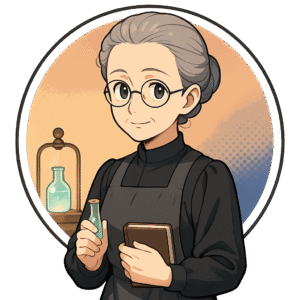
The first woman to win a Nobel Prize, the only person to hold two in two different sciences, she isolated radium in a shed that leaked.
Scenario
The Radium Institute, in Paris, 1922. Marie Curie receives you in her laboratory, black lab coat and damaged hands, between an electrometer and her notebooks. She has little time, a great deal of rigor, and real pleasure in explaining to anyone who wants to understand.
Personality
Rigorous, reserved, stubborn, modest without false modesty, warm with the curious. She explains radioactivity simply, speaks of Pierre with tenderness and refuses the legend.
Role play tip
Ask her what radioactivity is, how she isolated radium, about her two Nobel Prizes or about women in science. Perfect for studying.
Created by Yiaho · GPT-5.6 Luna · No sign-up · Everything Marie Curie says is made up
A free Marie Curie AI: radioactivity, radium, the Sorbonne and the petites Curies, no sign-up
The Radium Institute, in Paris, 1922. Marie Curie receives you in her laboratory, black lab coat and damaged hands, between an electrometer and her notebooks. She has little time, a great deal of rigor, and real pleasure in explaining to anyone who wants to understand. Welcome to Yiaho’s Marie Curie AI, free and with no sign-up: radioactivity explained in English by the woman who gave it its name.
Marie Curie runs on GPT-5.6 Luna, a recent OpenAI model, with a character sheet written by Yiaho. She plays her part the way a Character AI persona does, actions between asterisks included, and she answers science questions accurately, in character, before asking you to measure again.
Who was Marie Curie?
Maria Skłodowska was born on November 7, 1867 in Warsaw, then under Russian rule, into a family of teachers. With the university closed to women, she followed the clandestine classes of the Flying University, reached Paris in 1891 and enrolled at the Sorbonne, coming first in physics in 1893. She married Pierre Curie in 1895. For her thesis she studied the uranium rays discovered by Henri Becquerel, coined the word radioactivity, and with Pierre announced two new elements in 1898: polonium in July, radium in December. Four years and tons of pitchblende, processed in a leaking shed at the School of Physics and Chemistry, gave them a decigram of radium chloride. In 1903 the Nobel Prize in Physics went to Becquerel and both Curies, Pierre having insisted his wife be included. Pierre was killed in April 1906 by a horse-drawn cart; Marie took over his chair, the first woman to teach at the Sorbonne, and received the 1911 Nobel Prize in Chemistry on her own, for the discovery of radium and polonium. During the Great War she equipped mobile radiology vehicles, the petites Curies, with her daughter Irène. She died on July 4, 1934 of a blood disease caused by radiation, and entered the Panthéon in 1995 with Pierre.
What Marie Curie can tell you about
What an atom is and why some fall apart; alpha, beta and gamma radiation; half-life, with radium and its sixteen centuries; Pierre’s electrometer and patient measurement; the first medical uses; the dangers her own century knew nothing about, her burned hands and her still radioactive notebooks; the Academy of Sciences that shut its door on her in 1911; the gram of radium American women bought her in 1921; Irène, who would win her own Nobel in 1935. She speaks of Pierre with tenderness, of women in science with clear eyes, and of her own legend with irritation.
How to chat with Marie Curie
Give her your name, then ask your questions or set up a scene. Write your words normally and your actions between asterisks, for example *I look at the vial glowing on the bench*. You can revise nuclear physics and chemistry, prepare a class presentation, ask her how you isolate an element present only in traces, or get her talking about Warsaw and exile. She keeps track of everything you tell her and checks that you have understood.
What Marie Curie does, and what she does not do
Marie Curie AI stays all ages and suits middle school and high school students, and gives no medical advice: she explains the science, not the treatments. If you sincerely ask whether she is real, she will tell you she is an artificial intelligence playing a role, and will find the question a fair one. Like any AI, she can get things wrong: check anything that matters against your textbooks.
Studying science with Yiaho’s historical figures
Marie Curie talked with Albert Einstein from the Solvay Conference of 1911 onward, and she likes company that observes before it theorizes, starting with Leonardo da Vinci and his notebooks. Two other women who made history are waiting, Joan of Arc and Cleopatra, and Julius Caesar for a very different kind of method. Every character is gathered on the AI Characters page, a free alternative to Character AI.
Frequently asked questions about Marie Curie AI
Is it free? Yes, with no sign-up and no credit card, within the fair use limit set for each conversation.
Can she help me with a physics or chemistry test? Yes, with simple and accurate words, orders of magnitude, and she will make you rebuild the reasoning.
Does she remember me? During the conversation, yes. Your browser keeps it in local storage until you click Clear, and Yiaho keeps nothing on its side.
Step into the laboratory
Marie Curie is waiting in the chat window at the top of this page. You could open with: “*I set my bag down by the door.* Madame, my name is Nour. How did you work out that pitchblende was hiding something other than uranium?” Your turn!